by Alice Staples, Archives and Special Collections Librarian
How many alumni remember the assignment: walk around campus looking for specially marked trees and other plants and recording detailed information about each? Many alumni remember Dr. Herbert H. Lamson, a.k.a. “Lammie,” taking his classes out and about to study the local flora on campus and in Langdon Park. In the PSU archives I found the notes of one Grace Hoitt, who worked on this same assignment around the turn of the century-the 20th century, that is.
The University’s archive includes catalogs for most years from 1871 through the present. These catalogs are the documented history of the institution, reflecting changes in curriculum, residence life, campus buildings, rules and regulations, and more. As with a yearbook, there is an expectation that an institution’s archive will contain these and other regular publications. But the rare gems of the collection are the personal items that give a glimpse into the daily lives of students at Plymouth. Read More
By Elizabeth W. Cheney ’89, ’99G
When Karl Drerup came to Plymouth Teachers College in 1946 as the sole art instructor, little did he imagine the art department as it would grow to be in 2007. When Drerup retired in 1968, the department he founded comprised 10 instructors and 133 students. Today, the department boasts a dozen faculty, plus numerous adjunct teachers, and upwards of 575 students learning about art and art education in any given semester, as well as a public gallery named for Drerup. Read More
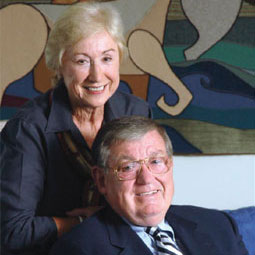
New Hampshire couple sets an inspirational example of civic engagement and philanthropy.
Web logs expand instructional toolkits in the classroom.

New facility is "model home" of environmental responsibility on campus.
by Barbra Alan
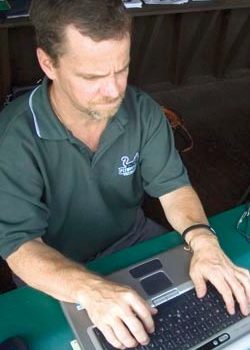
Plymouth State University has 19 women’s and men’s sports teams that play more than 250 games during the school year. It’s the job of the sports information director (SID) to ensure each game is promoted and the highlights and scores are publicized. It’s also the SID’s job to produce the athletic department’s publications and maintain its pages on the PSU Web site while overseeing home-game management. That’s a full plate by anyone’s standards. But it’s all in a day’s work for Kent Cherrington. Fortunately, the information age makes Cherrington’s awesome task of single-handedly promoting and publicizing PSU sports a bit easier. Read More
by Kevin D. Anderson

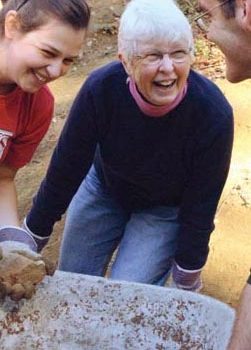
Conklin digs in at a local Habitat for Humanity project with numerous PSU student volunteers. Jon Gilbert Fox photo.
For Nancy Conklin, there was no great awakening or a voice telling her to do something; there was simply a genuine feeling that helping others was the right thing to do. It’s something she has been doing most of her life.
As a child, for example, Conklin helped out a less fortunate family by playing with the children, making them lunch, and doing her best to keep their spirits high. She is the true embodiment of the Plymouth State University motto Ut prosim (That I may serve). Conklin recently retired as the coordinator of PSU’s Community Service Center. Conklin also had a distinguished career as a secondary school librarian in different parts of the country. For a brief stint she even took her professional career inside the correctional system, spending a few years as a librarian at a women’s prison in Virginia in the early 1980s.
Conklin also spent a year as a VISTA (Volunteers in Service to America) volunteer in the greater Plymouth area. VISTA places people with community-based agencies to help find long-term solutions to problems caused by urban and rural poverty. Conklin’s work with the organization got her noticed. The school was looking to fill the newly created position of coordinator of the Community Service Center, and Conklin appeared to be the perfect match. She, in turn, was eager to work with people she had never worked with before: college students. Read More
by Christopher C. Chabot, Professor of Biology
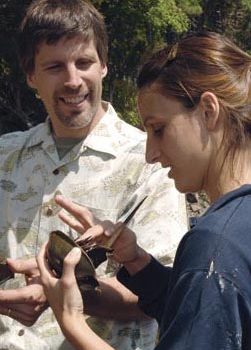
I have been teaching at Plymouth State for 15 years, and during this time, not only has the University changed, my teaching strategies also have changed. I have evolved from science teacher to teaching scientist, partly because of the realization that students learn science best by doing research and conducting experiments, and partly because of the increased opportunities for me to pursue research while teaching here. Read More
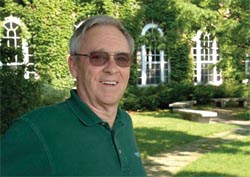
Henry “Joe” Long Jr.
Careers and Connections for Plymouth State Alumni and Students
When students decide to continue their education after high school, many of them do so believing a college education will lead to both a better life and financial security. However, a degree alone does not guarantee success. For many college graduates, career assistance is vital to making the most of the years they invested in furthering their education.
For years, Plymouth Teachers College and Plymouth State College had an informal career assistance program for our graduates. Many of our seasoned alumni worked in the field most of our graduates were entering—education— and would serve as mentors for the newest Plymouth State alumni.
Today, Plymouth State University graduates almost four times as many students skilled in a variety of disciplines. We are an institution that educates teachers, businesspeople, scientists, visual and performing artists, and more. However, we did not have a system in place to provide our graduates with career guidance and resources.
Now we do. Read More
by Mary Catherine Coolidge ’93
When I first encountered Shakespeare’s plays in college, it was as if my mind had found a place to live. Hamlet, RichardIII, HenryV, King Lear—these works changed my interior landscape from black and white to Technicolor. Shakespeare blew the lid off what I had known and understood about the bewilderment, love, and loss that make up man’s existence, but his plays were also mirrors in which I saw, for the first time, the not always innocent machinations of my own ego.
I studied Shakespeare with Dr. Henry Vittum, professor of literature at Plymouth State College, who also taught my advanced composition class. And though he would probably admonish the hyperbole, Dr. Vittum taught me nearly everything I know about critical thinking and writing well. Read More