Trails and Tribulations: A Changing of the Guard
By Rowan McCarthy
Published November 23, 2026
The seasons in New England maintain a constant ebb and flow, but to me, no other season invokes quite the same feelings as fall. No other season demands you to acknowledge the passing of time in the way fall does. Leaves begin to change from friendly greens to an ominous yellow, then orange, then gone. The sun goes from setting well after dinner time, to dinner time, to closing in on lunch. It’s this seasonal change that instills a sense of urgency in me to get outside and soak in the short window of vibrant foliage, warm temperatures, and long (enough) days before impending November and soon-to-follow December latch onto our lives with their dark and icy claws.
When buying a house, real estate agents often say that “location is everything,” and the same truth applies to where one chooses to go to school. When I chose to come to Plymouth, it had just as much to do with the outdoor recreational opportunities that surround campus as it had to do with the courses, professors, and cleanliness of the freshman-year dorm bathrooms. With miles of rivers and streams, more than 800,000 acres of public land to explore in the White Mountain National Forest, and plenty of skiing opportunities all just a stone’s throw away, I knew Plymouth would be the right choice.
My fall schedule always ends up being busier than I would like and busier than the fall before, with a myriad of responsibilities taking up time I’d rather be spending outdoors. Unfortunately, that is often the harsh truth for many of us at Plymouth, and for professors, the question isn’t if any of their students will skip class to hike or ski, but when. For me, the pull of free-flowing, sun-lit rivers and leaf-covered trails was often outweighed by the push of parental disappointment and lost scholarships, so I saved up most of my energy and time for outdoor adventures like it was some form of currency, cashing it in if I passed “GO” on Friday.
Several weekends involved prowling the boulder-strewn banks of the Pemigewasset River north of Lincoln with a fly rod in hand. Listening to the hydraulic churn of water over rock on its never-ending yet never-beginning journey to the Atlantic served as a sort of therapy, drowning out any other thoughts or worries from my stream of consciousness and washing them away. Hours passed quickly under the repetitive drone of the river and the repetitive motion of casting my insect imitation into tantalizing riffles and pools as I worked my way upriver. One Sunday, my line went taut as my fly swung under a boulder, and an especially healthy brook trout materialized out of the water in front of me. I scooped my net through the current to corral the catch and peered down at an orange belly, dark back, and bright white leading edges on its fins. Brook trout spawn in the fall, beginning to put on impressive displays of orange color as the nights grow colder, and as I watched the fish slip back to its underwater lair, the image of its fiery belly was engraved in my mind, reminding me that summer was gone, and winter was soon approaching.
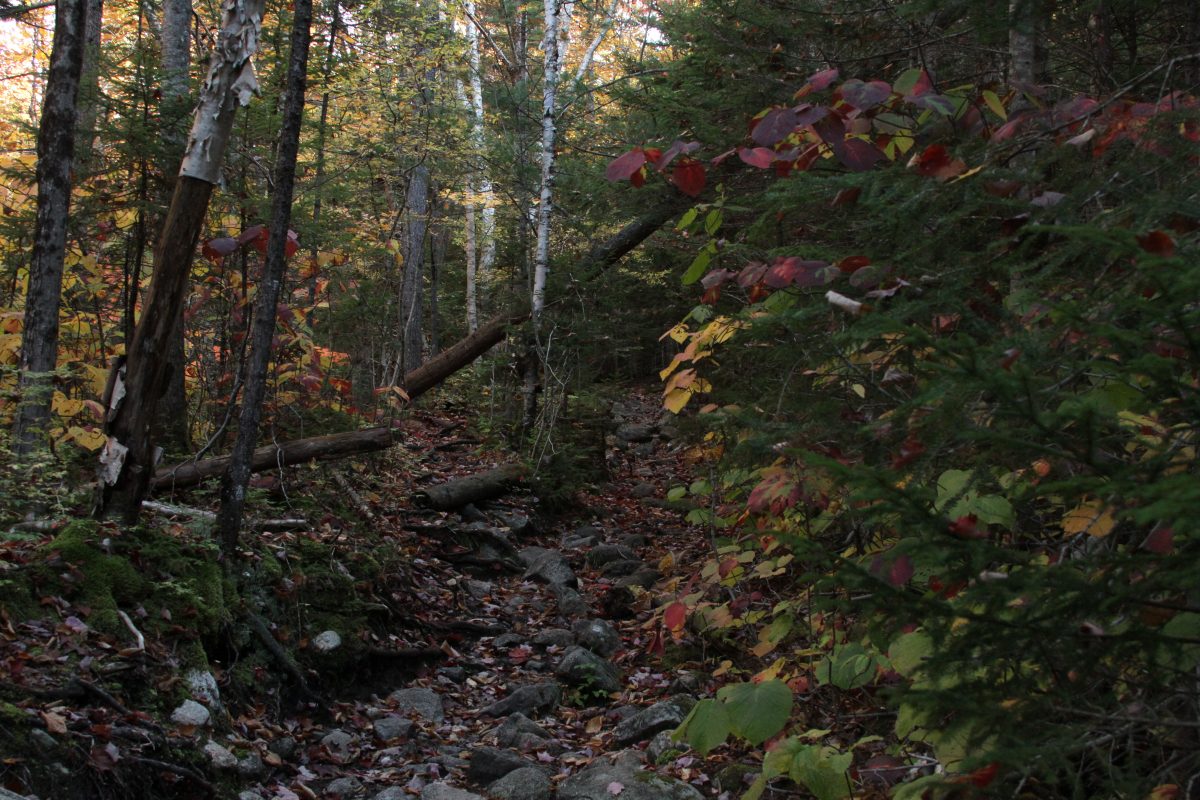
A few weekends later, on a Saturday night in mid-October, my breath clouded the cool night air illuminated by my headlamp as I set up my tent at the Franconia Brook Tentsite. My friend and I were off to do the Bonds, and we gave ourselves a little bit of a head start with a 3-mile hike into our campsite the night before, leaving the remaining miles for the next day once the sun was up. We woke up at sunrise the next day. Crawling out of a warm sleeping bag on a cold morning is always the hardest part of any camping or backpacking trip, and this morning was no exception. We reluctantly unzipped from the warm refuge of our bags and climbed into the waiting potential of our jackets and boots. We crossed the river over a downed tree just after sunrise and were quickly covering the remaining flat miles of the hike. The light was still low as we started to gain elevation through the dense forest, and as we came around one corner of the trail, a large bull moose appeared less than 20 yards ahead. It took up the width of the trail, its large antlers protruded into the surrounding pines, glassy white eyes stared back at the two unwanted visitors. Quickly stepping off the trail to avoid an unruly encounter, I tried to take out my phone and snap a picture, but before I knew it, the last species of megafauna in the region had somehow vanished into the thicket, and all that remains in my camera roll is a picture of where the beast stood on the trail just a moment prior.
The adrenaline from this encounter was enough to keep us going for a while, and before we knew it, we were breaking out of the tree line and taking in 360-degree views of the surrounding White Mountains from the ridge. The mountain tops and alpine zone gave nothing away with their constant green balsam firs and rock outcrops, but the lower slopes and valleys glistened gold and orange in the midday sun. Foliage was definitely peaking, and these were some of the most vibrant fall colors I had ever seen. The alpine air was crisp and cold, and the Presidential peaks to our east were shrouded in clouds, while the rest of the Whites enjoyed blue skies overhead. We threw our jackets back on once we got to the top of Bondcliff and enjoyed lunch while taking in the foliage and views. The sun was warm, but the stiff breeze carried a threatening chill, warning us of the cold winter which would soon be upon us. Taking in the expanse of public land in front of me, I felt grateful to go to school in an area where such a vast amount of natural beauty was such a short distance away.