
Plymouth State University Research Creates First Observation-Based Snowpack Climatology for the Northeastern U.S.
Plymouth, N.H. (October 20, 2026) – A Plymouth State University (PSU) graduate student has completed the first comprehensive observation-based snowpack climatology across the Northeastern United States, providing scientists with an unprecedented view of how winter snow conditions have changed over multiple decades.
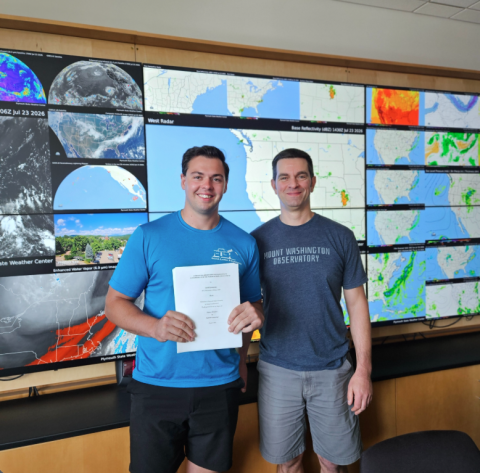
David Zywiczynski with his thesis adviser, Eric Kelsey, after completing his thesis on the first observation-based snowpack climatology for the northeastern United States. (Photo courtesy Plymouth State University)
The research compiled and standardized snow measurements collected between 1907 and 2025 from hundreds of observation sites across the Northeast, creating the first comprehensive historical record of regional snowpack. The work establishes an important benchmark that researchers can use to better understand how a warming climate is changing winter and what those changes could mean for flooding, drought, water supplies, ecosystems and winter recreation.
The study was completed as a master's thesis by graduate student David Zywiczynski and builds on a multi-year collaboration between Plymouth State University, the Northeast Regional Climate Center at Cornell University and the National Integrated Drought Information System (NIDIS) program of the National Oceanic and Atmospheric Administration (NOAA). It was funded by a $192,000 grant from NIDIS.
“Until now, we haven't had a climatological baseline of seasonal snowpack to understand what is normal throughout the winter,” Zywiczynski said. “This work gives scientists, forecasters and weather-reliant industries the historical context needed to prepare for and respond to the shifting availability of snow.”
Zywiczynski’s study found that the deepest, most persistent Northeast snowpacks occur in northern New Hampshire and Maine, while western and southern New York typically experience shallower snow that melts earlier in the spring. The analysis also shows that today's snowpack is generally not as deep as it was during the 1960s through the 1980s. Researchers continue to evaluate this using snow water equivalent (SWE), a measure of the amount of water contained in a snowpack. Real-time conditions and the climatological baseline for many Northeast locations can be found at the Northeast Climatological Snowpack Data Products website.
"The amount of snow that accumulates each winter has important implications for winter tourism, rain-on-snow flooding, and the potential for spring and summer drought," said Eric Kelsey, Ph.D., research associate professor and teaching lecturer at Plymouth State who supervised Zywiczynski. "Snowpack acts as a natural reservoir, storing water through the winter and gradually releasing it in the spring, with broad phenological and water-resource implications."
The research required assembling decades of records collected by numerous organizations and converting them into a single standardized dataset that could be analyzed consistently across the region. Zywiczynski also developed a new method to fill gaps in historical observations of snow-out dates.
During the next phase of the research, Kelsey will use the new historical dataset to develop the nation's first Snow Drought Index for the Northeast, a tool designed to help forecasters and water managers identify, monitor and assess winters with unusually low or high SWE.
The Snow Drought Index is expected to improve understanding of changing winter conditions and provide real-time information that can help communities prepare for flooding, water shortages and other climate-related impacts.
About Plymouth State University: Established in 1871, Plymouth State University serves the state of New Hampshire and the world beyond by transforming our students through advanced practices where engaged learning produces well-educated undergraduates, and by providing graduate education that deepens and advances knowledge and enhances professional development. The Plymouth State Cluster Learning Model emphasizes open, integrative, and project-based experiences. With distinction, we connect with community and business partners for economic development, technological advances, healthier living, and cultural enrichment with a special commitment of service to the North Country and Lakes Region of New Hampshire. To learn more about Plymouth State University, visit www.plymouth.edu.

