

You’ve always wanted to be on the cutting edge.
With a degree from Plymouth State University, you will have the knowledge, critical thinking and communication skills, and experience you need to solve real-world problems in the fields of computer science and information technology. Our department emphasizes a hands-on approach to learning built on top of extensive laboratory experience, individual interactions and support, and significant group projects.
This program focuses on the design and development of software systems with an emphasis on the creation of new technology. Students will build a framework of conceptual knowledge and practical skills through core computer science courses. A broad selection of electives offers the opportunity to delve into several of the application areas of Computer Science. Auxiliary courses in mathematics and science develop additional analytical skills necessary for success in the many computing specialties that graduates typically choose.
Connect with School of Science and Technology
Connect with us at School of Science and Technology via Email: Science.and.Technology@plymouth.edu or Phone: (603) 535-2533
Curriculum & Requirements
| Course | Title | Credits |
|---|---|---|
| Major Requirements | ||
| CS 2010 | Computing Fundamentals (TECO) | 3 |
| CS 2225 | Digital Logic Systems | 3 |
| CS 2370 | Introduction to Programming | 4 |
| CS 2384 | Intermediate Programming | 3 |
| CS 2470 | Systems Programming in C/C++ | 2 |
| CS 3223 | Data Structures & Algorithms | 4 |
| CS 3310 | Secured Web & Data System Development | 4 |
| CS 3510 | Artificial Intelligence & Machine Learning | 4 |
| CS 3720 | Systems Analysis and Design | 3 |
| CS 3780 | Introduction to Computational Theory | 3 |
| CS 3800 | Programming Languages | 3 |
| CS 4140 | Software Engineering | 3 |
| CS 4250 | Computer Architecture | 3 |
| CS 4310 | Operating Systems | 3 |
| CS 4520 | CyberEthics (DICO,WRCO) | 3 |
| CS 4760 | Senior Project | 3 |
| MA 2450 | Mathematical Reasoning | 4 |
| Science course with laboratory (not BIDI/CHDI/ESDI/MTDI/PHDI) | 4 | |
| Major Electives | ||
| Complete Nine (9) credits from the following: | 9 | |
CS 2900 | Digital and Analog Circuits | |
CS 2901 | Materials, Design and Fabrication | |
CS 2905 | PLC Programming | |
CS 3015 | Mobile Application Development | |
CS 3240 | Data Communication and Computer Networks | |
CS 3650 | Big Data Administration and Analysis | |
CS 4230 | System Administration | |
CS 4400 | Computer Networks and Protocols | |
CS 4920 | Computer Science Internship (maximum of three credits) | |
CY 2020 | Cybersecurity Fundamentals | |
CY 3010 | Ethical Hacking & Pentesting | |
CY 3020 | Network Security | |
CY 3030 | Digital Forensics & Incident Response | |
CY 3040 | Cloud Security and Privacy | |
CY 3100 | Red Team/Blue Team Capstone | |
| Math | ||
| MA 2550 & MA 3500 | Calculus I (QRCO) and Probability and Statistics for Scientists | 7 |
| Pathways HoME-General Education | ||
| IS 1115 | Tackling a Wicked Problem | 4 |
| Writing Foundation Course: | ||
| EN 1400 | Composition | 4 |
| Pathway Certificate * | 15-16 | |
| Additional Pathway Credits (0 if in major) 1 | 0-9 | |
| IS 4220 | Signature Project (INCO,INCP) | 4 |
| Electives | 16 | |
| Total Credits | 120 | |
- *
To complete the Pathways HoME General Education program, a student must complete 24 credits of Pathways courses, including those that lead to a Pathways Certificate. 15-16 credits of a Pathway Certificate must be in a single Pathway skill and must include at-least 8 credits of upper-division courses. Students may complete the remaining 8-9 credits with Pathway classes taken inside the major (double-counting) or outside of it. Students in this major may earn multiple Pathway Certificates; one must be a Pathway other than Quantitative Inquiry.
1 Major includes 8 credits of Additional Pathway courses
Check all course descriptions for prerequisites before planning course schedule. Course sequence is suggested but not required.
To complete the bachelor’s degree in 4 years, you must successfully complete a minimum of 15 credits each semester or have a plan to make up credits over the course of the 4 years. For example, if you take 14 credits one semester, you need to take 16 credits in another semester. Credits completed must count toward your program requirements (major, option, minor, certificate, general education or free electives).
| Year One | Credits | |
|---|---|---|
| EN 1400 | Composition | 4 |
| IS 1115 | Tackling a Wicked Problem | 4 |
| CS 2010 | Computing Fundamentals (TECO) | 3 |
| CS 2370 | Introduction to Programming | 4 |
| CS 2384 | Intermediate Programming | 3 |
| MA 2450 | Mathematical Reasoning | 4 |
| MA 2550 | Calculus I (QRCO) | 8 |
| Pathway Course | 4 | |
| Credits | 34 | |
| Year Two | ||
| CS 2470 | Systems Programming in C/C++ | 2 |
| CS 3310 | Secured Web & Data System Development | 4 |
| CS 2225 | Digital Logic Systems | 3 |
| CS 3223 | Data Structures & Algorithms | 4 |
| MA 3500 | Probability and Statistics for Scientists | 3 |
| Science course with Laboratory (not BIDI/CHDI/ESDI/MTDI/PHDI) | 4 | |
| Pathway Course | 4 | |
| Pathway Course | 4 | |
| Credits | 28 | |
| Year Three | ||
| CS 3780 | Introduction to Computational Theory | 3 |
| CS 3510 | Artificial Intelligence & Machine Learning | 4 |
| CS 4250 | Computer Architecture | 3 |
| CS 3720 | Systems Analysis and Design | 3 |
| CS 3800 | Programming Languages | 3 |
| Pathway Course | 4 | |
| INCP | Integrated Capstone | 4 |
| Major Electives | 6-8 | |
| Credits | 30-32 | |
| Year Four | ||
| CS 4520 | CyberEthics (DICO,WRCO) | 3 |
| CS 4140 | Software Engineering | 3 |
| CS 4760 | Senior Project | 3 |
| CS 4310 | Operating Systems | 3 |
| Major Elective | 4 | |
| Electives | 12 | |
| Credits | 28 | |
| Total Credits | 120 | |
- The ability to develop applications to solve small and large problems, both independently and as part of a team.
- An understanding of how the running time of algorithms is measured and the theoretical limitations of computing.
- An understanding of computer instruction-set architecture and experience with hardware-focused programming.
- The ability to communicate technical information to a wide range of audiences.
- An understanding of professional, ethical, and security issues and responsibilities that arise with modern socio-technical systems.
- Computer Programmer
- Computer Systems Manager
- Control Engineer
- Database Administrator
- Manager, Management Information Systems
- Network Administrator
- Quality Assurance Specialist
- Robot Software Engineer
- Robot System Engineer
- Software Designer
- Software Developer
- Software Engineer
- System Analyst
- Web Application Developer
- Technical Writer
- Web Designer
- Ability to analyze cause and effects
- Ability to think logically and critically
- Strong communication skills
- • Mathematical background
Explore Program Details
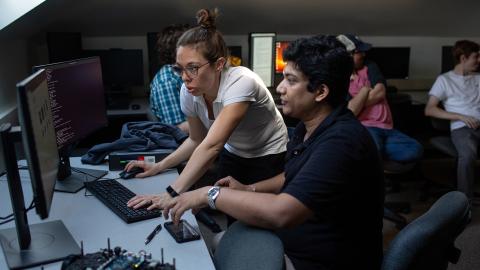
As a Computer Science and Technology student you will be part of a tight-knit community. We spend a lot of time working in teams on projects, playing games over lunch with professors, and asking questions during open tutoring hours. These connections not only keep the department lively, but also build a network that can provide career opportunities.
- Evening tutoring hours
- Internship and career opportunities
- Board game groups
- Meet and talk with alumni in the field
- Senior Project presentations


More to Explore
Explore Today.
Realize Tomorrow.
